

Minecraft ore generation 1.21 explains where every ore generates and the best Y-levels to mine for maximum efficiency.
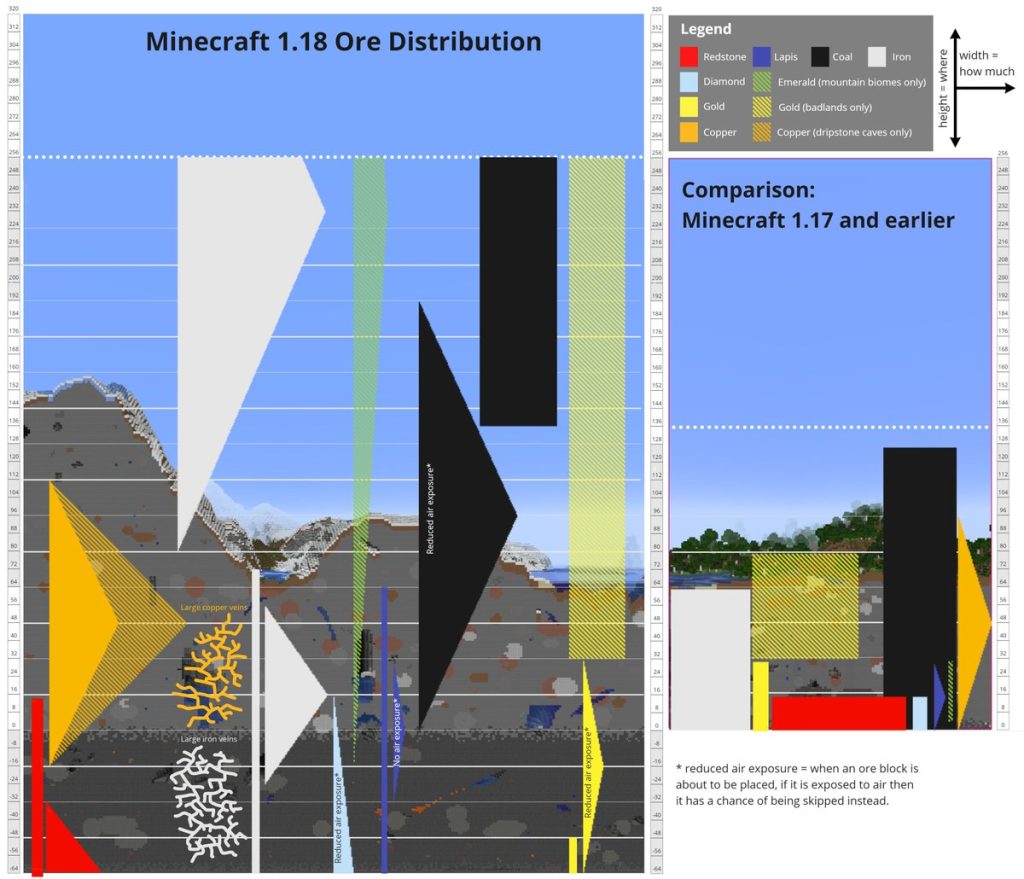
Minecraft’s ore generation system was completely overhauled in 1.18 (Caves & Cliffs Part 2). Instead of flat layers, ores now generate using distribution curves, meaning some Y-levels are significantly more efficient than others.
As of Minecraft 1.21.11, no further changes have been made to ore generation. This guide is fully accurate for 1.18 through 1.21.11.
Below you’ll find where each ore generates and the best Y-levels to mine for maximum efficiency.
Coal Ore #
- Generates between: Y 0 to 320
- Peak generation: Above Y 136
- Important notes:
- Coal is heavily reduced by air exposure below Y 136
- Caves are a poor source of coal at lower depths
Best method:
Mine at high altitudes or surface-mine in mountain biomes above Y 136
Iron Ore #
- Generates between: Y -64 to 320
- Two peak levels:
- Y 16 (underground)
- Y 232 (mountain peaks)
Best methods:
- Early-game: mine around Y 16
- Bulk iron: mine mountain biomes near Y 232
Copper Ore #
- Generates between: Y -16 to 112
- Peak generation: Y 48
- Biome bonus: Dripstone Caves
Best method:
Mine at Y 48 or explore Dripstone Caves, where copper is far more abundant
Gold Ore #
- Generates between: Y -64 to 32 (all biomes)
- Badlands bonus: Generates up to Y 256
- Peak levels:
- Y -16 (normal biomes)
- Above Y 32 (Badlands)
Best methods:
- Strip mine at Y -16
- In Badlands biomes, mine anywhere above Y 32
Redstone Ore #
- Generates between: Y -64 to 16
- Peak generation: Y -58
- Notes: Vein size increases at lower depths
Best method:
Strip mine or tunnel at Y -58
Lapis Lazuli Ore #
- Generates between: Y -64 to 64
- Peak generation: Y 0
- Notes: Small but frequent veins
Best method:
Strip mine at Y 0
Diamond Ore #
- Generates between: Y -64 to 16
- Peak generation: Y -58
- Important notes:
- Diamond generation is reduced by air exposure
- Large deepslate caves still expose many diamond blocks, making them effective early-game
- Strip mining provides higher long-term efficiency, while caving offers faster early discovery
Best methods:
Mid–late game: Strip mine at Y -58 for maximum efficiency
Early game: Explore large deepslate caves below Y -30
Emerald Ore #
- Generates between: Y -16 to 320
- Biome restriction: Mountain biomes only
- Generation pattern: Even distribution at high altitudes
Best method:
Mine between Y 224 and 320 in mountain biomes
Minecraft Ore Generation 1.21 – Quick Reference Table #
| Ore | Best Y-Level | Notes |
|---|---|---|
| Coal | 136+ | High altitude only |
| Iron | 16 / 232 | Underground or mountains |
| Copper | 48 | Dripstone caves boost |
| Gold | -16 / 32+ | Badlands advantage |
| Redstone | -58 | Large veins |
| Lapis | 0 | Small but common |
| Diamond | -58 | Amounts reduced in caves |
| Emerald | 224–320 | Mountains only |
Why These Levels Matter #
Minecraft now uses triangular and trapezoidal distribution curves, not flat layers. Mining at the correct Y-level can double or triple your ore yield compared to random caving.
This system has remained unchanged from 1.18 through 1.21.11, making this guide safe to rely on long-term.
Mining Strategy Tips (Early vs Late Game) #
Early-game players will often find ores faster by exploring large caves, especially in deepslate layers where visibility is high. While ore density is slightly reduced due to air exposure, caves expose far more blocks per minute than strip mining with basic tools.
Later in the game, strip mining at optimal Y-levels becomes more efficient once players have enchanted tools, beacons, and faster mining speed. Combining both methods is the most effective way to gather resources throughout a survival world.
Does Ore Generation Change Between Versions? #
Ore generation has remained unchanged since Minecraft 1.18, when Mojang introduced the new world height and distribution curve system. Versions 1.19, 1.20, and 1.21 have not adjusted ore Y-levels or spawn rates in the Overworld.
Because of this, guides written for Minecraft 1.18 remain accurate for 1.21.11, with the main difference being newer biomes and structures rather than changes to ore placement.


